Remediation

For site decontamination

Environmental

remediation


Environmental remediation work is required when Phase II and Phase III environmental evaluation yield contamination levels above those set out by government standards. Remediation allows polluted soil to be brought up to current environmental standards. We start by removing the sources of pollution and implementing control measures to prevent further contamination.

Several factors are taken into consideration when determining the appropriate decontamination method to employ: project costs, the presence of structures and infrastructures, accessibility to the site, time constraints, the size of the site, the amount and type of soil to be decontaminated, the nature of the contaminants and the technologies available.


Stages of environmental remediation:

  • Intervention planning;
  • Decontamination work;
  • Sampling of soil, groundwater, surface water and sediment;
  • Laboratory analysis;
  • Data interpretation;
  • Drafting reports.

Our environmental remediation work complies with the requirements of the Politique de protection des sols et de réhabilitation des terrains contaminés and the Guide de caractérisation des terrains of the Ministère de l'Environnement et Lutte contre les changements climatiques du Québec.

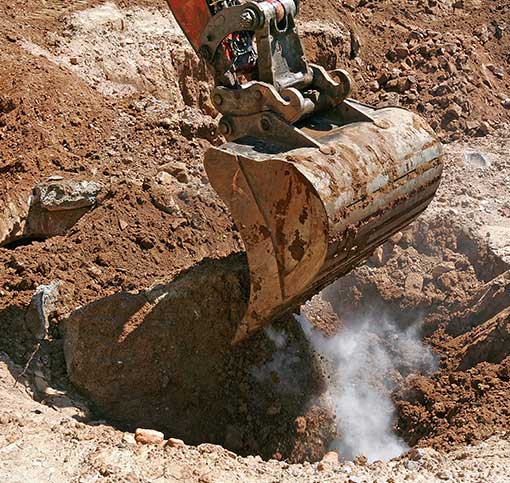
Des travaux de décontamination du sol sont exécutés en vue de la réhabilitation d’un terrain résidentiel à Sherbrooke.

There are two types of triggers in Quebec:

Legal obligation — permanent cessation of an activity designated in Schedule III of the RPRT (section 31.51 EQA), a change of use of a contaminated site (section 31.53), or a notice from the Minister (section 31.43 et seq.). If the site assessment shows an exceedance of the limit values in Schedule II of the RPRT, a rehabilitation plan must be approved before work begins.

Voluntary action — to allow a sale, to lift a notation on the land register, to remove a site from the Contaminated Sites Registry, or to meet a financial institution's requirement.

The mere presence of contamination does not automatically trigger the obligation — it is the combination of the contamination level, the intended use, and the legal context that determines the obligations.

Most of Envirosol's decontamination mandates fall under voluntary action — typically as part of a real estate transaction, a refinancing, or a redevelopment project, where the client chooses to act to lift a constraint rather than under a direct legal obligation.

Three categories, based on where the treatment takes place:

  • Excavation and off-site management — the most widely used method in Quebec. Soils are classified (A-B, B-C, C-D, >D) and sent to biotreatment centres, thermal desorption facilities, contaminated soil landfill sites (LESC), or recovery facilities. Fast and predictable, but costly for large volumes.
  • In situ treatments (no excavation) — bioremediation (hydrocarbons), soil vapour extraction (SVE) for VOCs, in situ chemical oxidation (ISCO) using permanganate, persulfate, or peroxide, pump-and-treat for groundwater. Lower initial cost, but often takes years.
  • Ex situ on-site treatments — biopiling on a sealed, ventilated pad, screening to separate coarse/fine fractions, soil washing for fine-grained metals.

The choice depends on five parameters: type and concentration of the contaminants, soil permeability, affected volume, depth relative to the water table, and site constraints.

Envirosol can carry out excavation and off-site management in-house. In situ treatments are handled by our own team for small contracts and entrusted to specialized partners for larger-scale projects. Ex situ on-site treatments are systematically carried out by our accredited partners, under Envirosol's supervision.

The cost varies according to: contamination level (B-C in biotreatment at moderate cost, C-D in an LESC or thermal desorption at high cost, >D in specialized treatment), volume (excavation becomes unfavourable beyond a threshold where in situ treatment becomes competitive), type of contaminant (hydrocarbons are the least expensive; chlorinated solvents, PCBs, and heavy metals are much more expensive), accessibility (a dense urban site costs several times more than an open site), and whether groundwater is involved.

As a general indication, removal and disposal typically range from a few tens to several hundred dollars per metric tonne. An accurate quote always requires the results of a Phase 2 or Phase 3 site assessment.

As an order of magnitude, a very small decontamination starts at around $12,000. This floor amount covers all the costs involved in a mandate from A to Z: receiving-site fees, management of the contaminant involved, tonnage of contaminated soil, sampling, as well as the machinery and transportation required.

It depends on the regulatory situation:

  • A rehabilitation plan approved by the Minister before work begins, when concentrations exceed the limit values in Schedule II of the RPRT in the situations set out in the EQA. It must be signed by a professional under section 31.42 EQA (a recognized professional order or an AQVE EESA®). The final report is filed at the end.
  • A declaration of compliance under the REAFIE for moderate-risk projects — a faster route.
  • No formal provincial authorization for voluntary rehabilitations below the thresholds, but the project remains subject to municipal rules and to the Regulation respecting the traceability of excavated contaminated soil.
  • A municipal permit and an Info-Excavation notice: practically always required.

Envirosol carries out about twenty rehabilitation projects per year. Cases triggered by a cessation of activity remain rarer in our practice.

The destination depends on the contamination level: A-B can be recovered as fill under certain conditions; B-C is directed to biotreatment or controlled recovery; C-D goes to an LESC or thermal desorption; >D undergoes high-temperature thermal treatment or specialized landfilling.

Three Quebec regulations apply:

  • Regulation respecting the landfilling of contaminated soil (RESC) — CQLR c. Q-2, r. 18;
  • Regulation respecting the storage and transfer centres of contaminated soil;
  • Regulation respecting the traceability of excavated contaminated soil — in force since 2023, requiring digital tracking through Traces Québec with truck geolocation, electronic manifests, and certification of each destination.

The project owner remains responsible for the traceability chain through to the final destination, even if transportation is subcontracted.

Envirosol regularly works with recognized facilities such as Biogénie, Northex, and Enfouibec. The final choice is made case by case, based on the authorized facility closest to the site being rehabilitated that accepts the contamination level of the excavated soil — a criterion that optimizes timelines, transportation costs, and the project's environmental footprint at the same time. The carrier, in turn, is selected based on the specific needs of each contract.

Depending on the method and the scale:

  • Simple excavation (residential fuel oil spill): a few days to 2-3 weeks.
  • Complex industrial excavation: 2 to 6 months, including planning, authorizations, zone-by-zone excavation, groundwater management, and restoration.
  • In situ or ex situ bioremediation: 6 months to 2 years depending on the contaminant, temperature, and kinetics.
  • Pump-and-treat or ISCO: several months to several years with periodic monitoring.
  • Monitored natural attenuation (MNA): 5-15 years for groundwater plumes.

For projects submitted to the MELCCFP, add the plan approval time to the execution time.

As a concrete example of a fast response, Envirosol intervened within hours of a motor oil spill from a dump truck in Bury. The final report with results was completed in under 5 business days. This kind of emergency mobilization is made possible by the fact that our teams and our drilling equipment are available in-house, without depending on a subcontractor.

Yes, when the legal thresholds are reached. Under sections 31.58 et seq. of the EQA, a notation is entered in the land register when the soil concentration exceeds the limit values in Schedule II of the RPRT. This notation informs future buyers and remains public until rehabilitation is complete. It can be struck off at the end of the work upon a professional's attestation (section 31.42 EQA) confirming compliance with the criteria applicable to the site's use.

This should be distinguished from the MELCCFP's Contaminated Sites Registry, a separate (but similar) administrative registry. Striking the notation off the land register generally requires filing a final report approved by the MELCCFP, followed by a notarial process.

Envirosol supports its clients throughout the post-rehabilitation notation removal process, from preparing the professional attestation to coordinating with the notary responsible for the land register entry.

Since Bill 102 (in force since April 12, 2023), the former ministerial list of experts (former section 31.65 EQA) has been abolished. The new regime, under section 31.42 EQA, requires the signatory to be:

  • A member of a recognized professional order — typically the OIQ (rehabilitation, the most common signatory), the OGQ (hydrogeology, groundwater plumes), the OTPQ (professional technologists with the appropriate specialty), the OAQ (agricultural sites), or the OCQ (advanced analytical interpretation);
  • A holder of the EESA® designation awarded by the AQVE (ISO/IEC 17024 accreditation).

The signatory must have the specific competencies relevant to the matter (a professional ethics obligation). In addition, the usual requirements for a rehabilitation contractor apply: an appropriate RBQ licence and adequate civil liability insurance.

Envirosol has in-house professional technologists who are members of the OTPQ and are authorized to sign these documents. Envirosol also holds RBQ licence 5822-3439-01.

Need a quote?

Contact us for a free quote and let our team of experts guide you in the environmental management of your project.